

Frequently Asked Questions
See our Frequently Asked Questions to help you find the right system for your business.
There are three key things to consider when purchasing Steel Storage Racking.
1. Is it compliant to the current Australian Standards? Make sure you clarify this with the supplier.
2. Is it a major brand that has back up materials easily available in your area?
3. Are the materials Imported or Australian made? Finally if you are looking for independant, un-bias advise please dont hesitate to contact us.
The easiest way to determine the brand of your existing racking is to look at the hole patterns in the frame uprights. Below is a list of the most common types of pallet racking found in Australia.
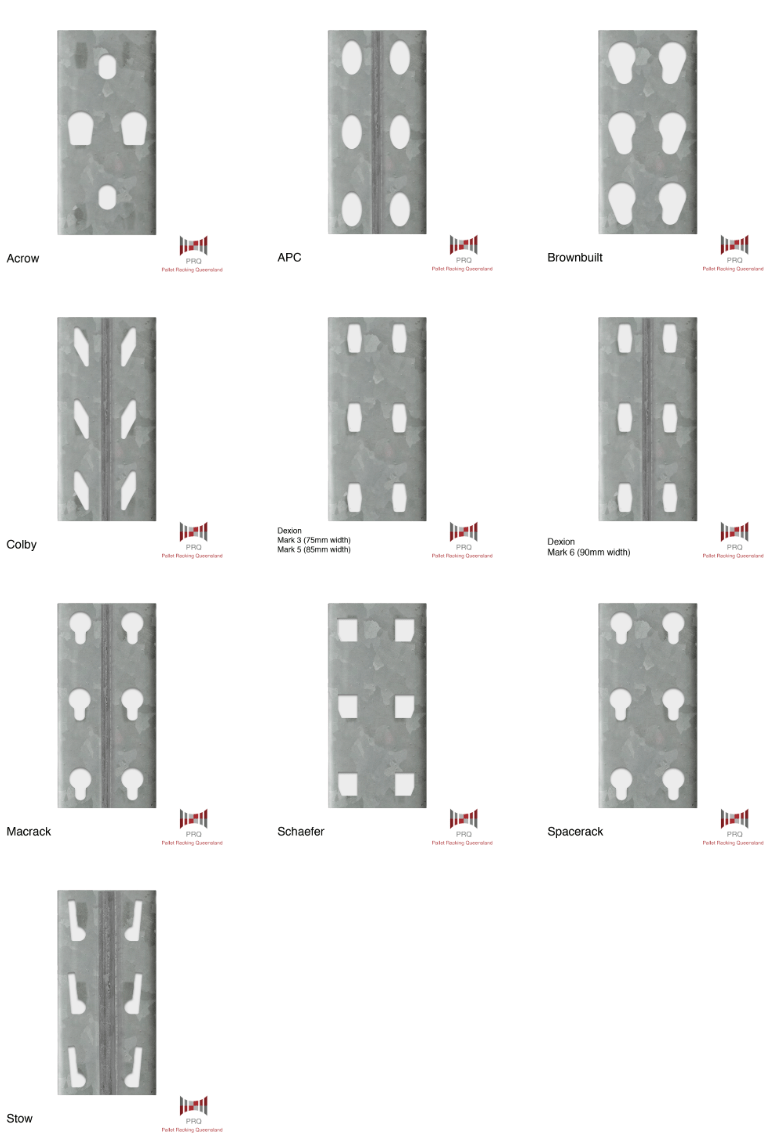
There are a wide range of products available and the picture below lists out many of the options:
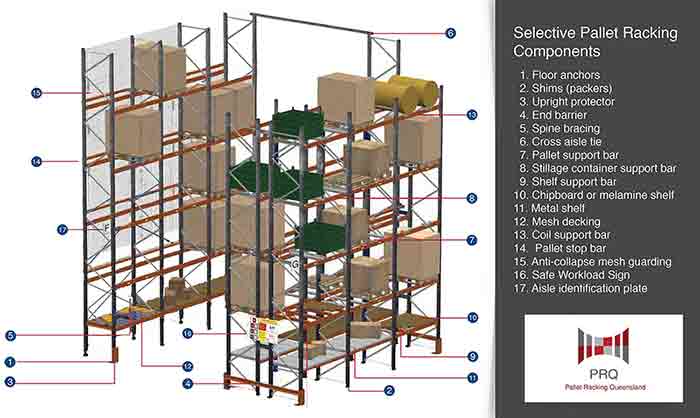
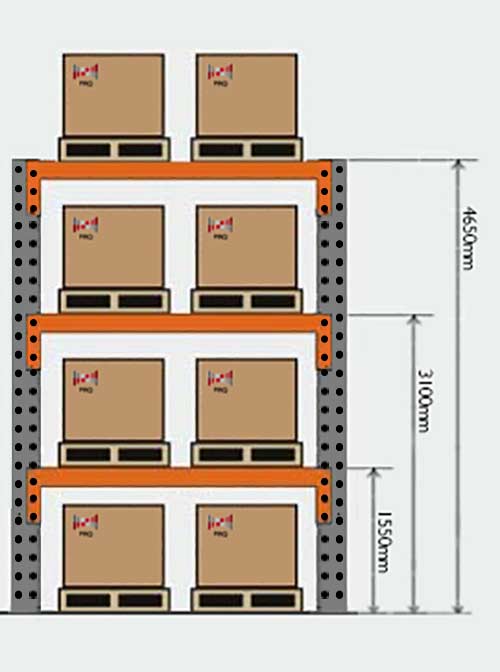
Let’s assume that you use standard fully loaded pallets with dimensions of 1200mm x 1200mm x 1300mm (Diagram 3.1). Note this can vary and some pallets can be longer, wider, shorter or taller. In addition, you leave a recommended minimum clearance of 150mm between the top of a pallet and the bottom of the beam above it (Diagram 3.2).
Using these assumptions then beams (Diagram 3.3) on a double pallet bay should be placed at:
- 1550mm for a 1 level pallet rack (4 pallets)
- 3100mm for a 2 level pallet rack (6 pallets)
- 4650mm for a 3 level pallet rack (8 pallets)
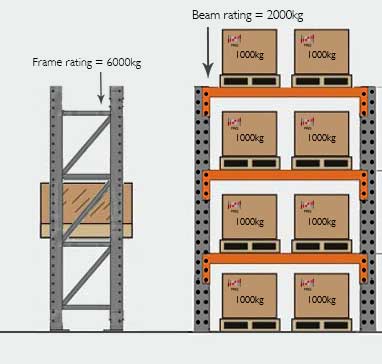
Pallet racking is rated on both upright frames and on beams. Assuming that each of your pallets are carrying 1000Kgs (Diagram 4.1) of product and you have 3 levels of 2 pallets on each shelf then your beams need to be rated to 2000Kgs and your upright frames need to be rated to 6000Kgs.
Here’s an illustration to show how rack rating works:
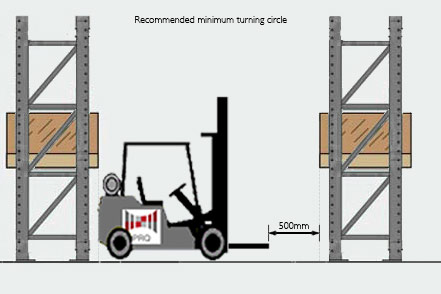
As a general rule, rack spacing depends on the length of your forklift. PRQ recommends adding 500mm to the length of your forklift (from the rear of the chassis to the tip of your tynes) as a minimum forklift turning circle.
Three factors for the right racking height:
- Warehouse storage density required. If you need a lot of products in your warehouse then definitely utilise its full height. If you don’t have a high density requirement then going too high with your racking is negative. The time and skill required in forklifting to high racks is not required when you can simply utilise lower racking.
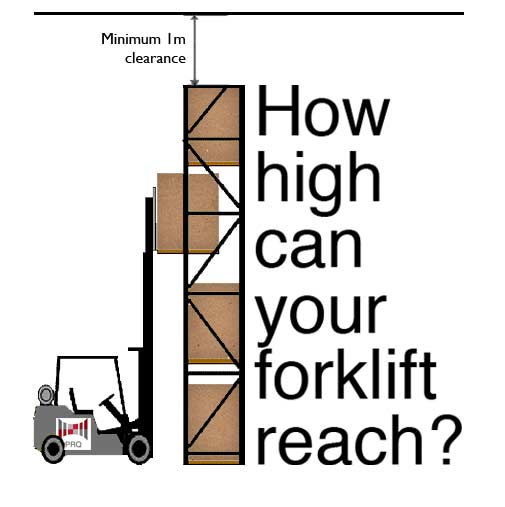
- Forklift reach. Make sure your forklift tynes reach the height of your racking and your forklift is rated to lift pallet loads to that height.
- Height of your warehouse. It is recommended to leave a clearance of 1 metre between the top pallet and you warehouse ceiling
If damage is identified, the inspector will generally classify the severity of the issue and recommend whether the racking should be repaired, monitored or replaced. Any safety risks should be addressed as soon as possible to reduce the chance of accidents and equipment failure.
The cost of a pallet racking inspection depends on factors such as warehouse size, the number of bays, site locations and the complexity of the inspection. Contact PRQ Australia for a tailored, no-obligation quote based on your requirements.
AS4084:2023 is the latest revision of the Australian Standard for steel storage racking. It includes updated guidance relating to rack design, operation, maintenance and safety. Businesses should ensure their racking systems and inspection programs align with the latest requirements where applicable.
The right racking solution depends on your inventory, warehouse layout, pallet volume and accessibility requirements. Selective pallet racking is ideal for businesses needing access to every pallet, while drive-in, cantilever and other specialised systems suit different storage applications.
At minimum, once every 12 months by a competent, independent inspector — this is a requirement under the current Australian Standard (AS4084), not just a recommendation. Beyond the formal annual inspection, your own staff should conduct regular visual checks as part of normal warehouse operations, reporting any visible damage immediately rather than waiting for the next scheduled audit.
Under Australian WHS legislation, businesses (PCBUs) have a duty of care to ensure pallet racking and other workplace structures are maintained in a safe condition. Regular independent inspections are widely recognised as a best-practice approach to meeting these obligations and helping demonstrate compliance with AS4084 requirements. Annual inspections are commonly recommended to identify damage, safety risks and potential compliance issues before they become serious hazards.
Formal annual inspections must be carried out by a “competent person” — someone with genuine industry experience as a racking designer, engineer, or installer, or equivalent demonstrated expertise. A general maintenance worker or forklift driver doing a quick visual check doesn’t meet this standard for a formal compliance inspection, though their day-to-day damage-spotting is still a valuable part of your overall safety process
Our inspectors visit your site and assess your racking against the current Australian Standard, checking for damage, incorrect loading, missing safety components, and signage accuracy. You receive a detailed report identifying any issues, a repair quote if work is needed, and a compliance letter confirming your racking meets the Standard — valid for 12 months until your next inspection is due.
In many cases, yes. Existing systems can often be modified, repaired or expanded using compatible components. An inspection can help determine whether an upgrade is viable or if replacement is the safer and more cost-effective option.
Common warning signs include bent uprights, damaged beams, missing safety clips, corrosion, impact damage and incorrect load signage. A professional inspection can determine whether the racking should be repaired, monitored or replaced.